
The Homeowner’s Guide to Short-Term Renting for the 2026 FIFA World Cup

The 2026 FIFA World Cup will bring millions of visitors and unprecedented demand to 11 U.S. host cities—and many homeowners are considering turning their home into a short-term rental to capture the surge.
Major events like the World Cup pack enormous demand into just a few weeks, creating both exciting revenue potential for property owners and even higher stakes for anyone renting their home, making preparation even more important.
But before jumping in, it’s important to understand what hosting actually entails—especially if you’ve never listed your home on Airbnb or Vrbo before. While booking platforms make it easy to list your property, renting your primary residence to paying guests, even for a short window, comes with added responsibilities for the property owner, host, rental arbitrageur, or co-host.
This guide breaks down what to expect when you short-term or mid-term rent your home for the World Cup, the risks hosts often overlook during major events, and how to prepare your property for guests.
- Should You Rent Your Home for the 2026 FIFA World Cup? Here's What Homeowners Should Consider First
- The Risks of World Cup Hosting: Elevated Exposure to Accidents, Incidents, Injuries, and Claim Denials
- What Hosts Need to Do Before World Cup Hosting for Real Protection
- Frequently Asked Questions About Renting Your Home for the 2026 World Cup

Should You Rent Your Home for the 2026 FIFA World Cup? Here’s What Homeowners Should Consider First
For the first time since 1994, the World Cup will return to the United States, bringing record-breaking travel demand to key host cities across the nation, which has many homeowners asking the same question: Should I rent my home for the World Cup?
With hotels already projected to sell out and nightly rates expected to skyrocket, the opportunity is real: booking for a few weeks during the World Cup may generate more income than an entire season of typical travel. When FIFA announced that 11 U.S. cities would serve as the primary host for the 2026 soccer championship, homeowners in Kansas City, Dallas, Atlanta, Miami, Los Angeles, Philadelphia, Seattle, Houston, Boston, the San Francisco Bay Area, and New York/New Jersey began seriously considering whether opening their home to guests made sense for them.
For many, renting your home for the World Cup seems like a smart move—a chance to earn meaningful income in a short time span. But high demand doesn’t automatically equal “easy money.” Short-term renting or Airbnbing your home during a global tournament isn’t the same as a casual weekend booking. Travelers from around the globe arrive excited, stay out late, are likely unfamiliar with the area, move through the home with less caution, and expect a higher level of readiness and responsiveness from the host.
What Does Short-Term Renting Actually Entail?
If you’re new to short-term rentals, it helps to remember that hosting isn’t just listing your property for the event, handing over your keys, and deciding whether to rent is about more than solidifying nightly rates. It’s about understanding what hosting actually requires:
- Start with what you’re comfortable offering: Renting your entire home feels very different from renting an ADU or separate apartment, and each option changes how much privacy you give up and how much preparation you’ll need.
- Know your own risk tolerance: World Cup guests travel in groups, stay out late, and use the home heavily. If the idea of strangers using your space or belongings makes you uneasy, that’s an important signal.
- Understand how event-driven hosting changes guest expectations: Guests operate on match schedules and expect fast communication, clear instructions, and a more professional level of hospitality than a typical weekend stay.
- Talk to your neighbors early: Event weeks mean more activity, more cars, and more noise; a quick heads-up and clear parking expectations can prevent complaints or enforcement issues.
- Consider the preparation required: You’ll likely need to remove valuables, secure personal items, and ensure everything works. Event weeks also strain local resources—cleaners, handypeople, and supply stores are busier than usual—so small issues can take longer to resolve.
- Set house rules: Visitors may be traveling domestically or internationally to a home and city that’s unfamiliar. By creating house rules in a printed manual or QR code resource, you can supply guests with crucial safety information like the location of fire extinguishers and first aid kits, emergency contact numbers, and plans of action during an emergency. Having a clear source of information and making guidelines for paying guests in your home can help garner more trust, but more importantly, maintain safety and support for visitors during their World Cup stay.
- Address safety issues before guests arrive: The quirks of your home that you’ve learned to live with can quickly become hazards for guests. A hallway rug that slides, a loose stair tread, a dimly lit walkway, or a wobbly deck rail might feel minor to you, but a guest won’t know how to avoid them—and that can create real safety and liability exposure.
If this level of activity and preparation matches your comfort level, hosting may be a rewarding opportunity. If not, that’s important to recognize early. A clear understanding of the risks associated with World Cup hosting should guide your next steps.
Preparing for Short-Term Renting?
Download the only checklist you’ll need to prepare Airbnb for guest safety, liability protection, and rave-worthy stays.
What to Anticipate When Renting Your Home for the World Cup
Hosting during the World Cup can be one of the most financially rewarding short-term rental experiences a homeowner can take on. With heightened nightly rates and a steady stream of soccer fans, your property can perform exceptionally well during this short period of time. But high demand also changes how guests use a home — the pace, pressure, and expectations feel very different from a normal stay.
Major events require hosts to be intentional and prepared, especially when converting a property into a short-term rental. To help you make an informed decision, here are the two biggest changes you can expect when hosting during the World Cup.
Expect to Take on a Hospitality Role
Renting your entire home or a second property means welcoming guests into a space filled with your furniture, appliances, and personal belongings. During event weeks, excitement and celebrations naturally increase the likelihood of both accidental and intentional damage, and increased movement and heavier use of kitchens, bathrooms, HVAC systems, and shared areas can quickly amplify wear and strain on systems.
Before deciding whether to rent your home for the World Cup, it helps to understand what “hosting” truly involves. Renting your home, even for a short stretch, means temporarily stepping into the role of a hospitality provider.
Guests expect clean, well-organized spaces; working appliances; clear house rules; safe conditions; and the same level of readiness they’d find in a professionally managed Airbnb. Event weeks also heighten expectations—response times, communication, and preparation all matter more than they would during a normal booking.
Expect A Shift in How You View Your Home
For many homeowners, the biggest adjustment isn’t the preparation; it’s the mindset shift.
- Are you comfortable with guests using your things? Hosting means having strangers in your personal space. Your furniture, décor, kitchenware, rugs, artwork, gear, and everyday household items suddenly become shared-use items. Your personal risk tolerance is a major part of deciding whether hosting is the right fit.
- Are you ready for the elevated risk of accidents, incidents, and guest injuries? Event-driven hosting concentrates more risk into a shorter period: more guests, more foot traffic, more alcohol, more celebrations, and a higher chance of property damage and liability claims.
- Are you able to absorb the financial hit if something goes wrong? And if a burst pipe, kitchen fire, or guest-caused damage forces you to cancel high-value bookings, the financial hit can be two-fold: loss of anticipated revenue during World Cup weeks and the potential for huge out-of-pocket expenses due to damage that standard policies don’t cover.
Understanding these foundational pieces—what hosting requires, what you’re offering guests, and how comfortable you are with strangers in your space—helps you take advantage of the opportunity, not shy away from it.
The World Cup Is Global, But Local Laws Still Apply
Continue learning with city-specific laws and income projections for the World Cup in our full city-by-city breakdown.

The Risks of World Cup Hosting: Elevated Exposure to Accidents, Incidents, Injuries, and Claim Denials
Short-term rentals already come with everyday risks. Layer in enthusiastic soccer fans, and a compressed event schedule, and those risks become far more concentrated.
As your short-term rental becomes a home base for global travelers, there is a higher chance for slip-and-falls on stairs or patios, cuts and burns in the kitchen, fire-pit accidents, and hot-tub mishaps—all of which could be tied to you, the host of the property, who handed a guest the keys.
Your largest exposure as a host during the World Cup isn’t damage, it’s liability.
This elevated pace means accidents, incidents, and injuries can happen more easily, especially when so much activity is packed into a short window—and if you don’t have the right insurance in place, it becomes even more complicated.
Short-Term Renting Your Home Is a Violation of Your HO Policy
Once you allow paying guests to stay in your home, your standard Homeowners (HO) policy becomes void entirely. HO policies are written for personal use only, not for business activity like hosting on Airbnb or Vrbo. These policies contain a “business activity exclusion” which ultimately grants the insurer the right to deny any claim.
Even a single World Cup stay is considered a business activity, and because most Homeowners policies are an annual contract, a two-day World Cup rental in June can be the reason a tree damage claim gets denied in November.
So, How do Homeowners Get Insurance Coverage for Short-Term Renting for the World Cup?
The recommended comprehensive solution would be a full replacement policy like the Commercial Homeowners policy by Proper Insurance, which is built to respond to injuries, liability risks, property damage, and other STR-specific risks.
There is a band-aid solution most insurance brokers will suggest: an endorsement to remove the business activity exclusion in your policy. However, that still leaves you as the host vulnerable to guest injury and other key liability protections, has low coverage for content damages (~$2,500), weak income protection, and more.
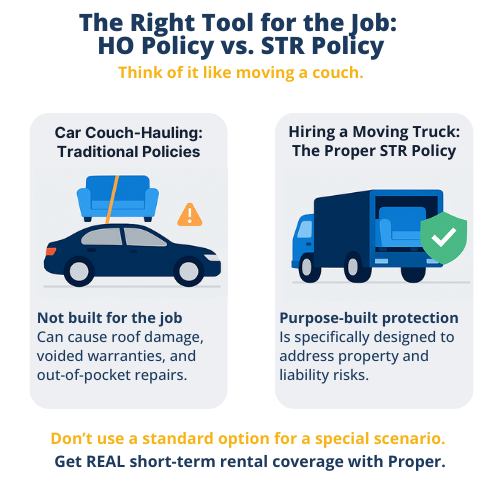
Think of it like moving a couch. You could strap it to the roof of your everyday sedan because “you already paid for the car,” but that doesn’t mean the car was built for the job—it can wreck the roof, void the warranty, and leave you footing the repair bill.
Short-term renting your home under a HO policy is the same idea. The only option that protects both the coverage of your property and addresses your short-term rental activity is to get a comprehensive vacation rental insurance policy. Skipping this step or trying to rent your home under a Homeowners policy is a violation of your annual contract, exposing you to claim denials or policy cancellations.
Without a specialized STR policy, you’re facing the same (if not heightened) risks of hosting on your own. The correct process may be a hassle, but even worse would be dealing with an uncovered water damage or slip-and-fall claim.
You Could See a World of Guest Damage that Traditional Insurance Won’t Cover
Guest-caused damage can also spike during major tournaments. An oven putting in overtime before a match, clogged toilets, damaged walls from fist-activating penalty kicks, and even malicious acts are common during event-driven hosting. Events like the World Cup compress weeks’ worth of occupancy into a matter of days, meaning your property faces stress long before a cleaner or maintenance technician has the chance to remedy it.
And while homeowners often assume their personal policy protects them, many are surprised to learn that guest-related damage and loss is excluded from a typical Homeowners or Landlord policy was built to handle. Traditional Homeowners (HO) and Landlord (LP) policies exclude guest-caused damage altogether due to property entrustment—the moment you hand over the keys, you’ve “entrusted” the home to the guest, and many policies interpret any resulting damage as the guest’s responsibility, not an insurable loss. That creates major gaps around accidental damage, intentional acts, and damage to your furnishings, property, or personal belongings.
But with the right setup and the right insurance, World Cup hosting risks become more than manageable. Proper’s Commercial Homeowners policy was designed around this short-term rental exposure, ensuring hosts can operate confidently, especially during peak demand weeks.

Alcohol + World Cup Fans + Short-Term Rentals = A Rowdy Risk
Fans often return from matches charged with excitement, continue celebrating late into the night, and unintentionally increase the risk of alcohol-related incidents. Even when hosts do not provide alcohol, guests will bring their own, and a wet kitchen floor, slick deck step, or misjudged movement can lead to an injury or property damage claim.
But the risk doesn’t stop at the property line. If an intoxicated guest leaves your home and injures themselves, hosts are often included in the lawsuit. Many homeowners are surprised to learn that even something as simple as a welcome bottle of wine or leftover liquor in the cabinet can be interpreted as “providing” alcohol in the eyes of the law.
Standard Homeowners (HO) and Landlord (LP) insurance policies exclude alcohol-related liability exposures. That’s why Proper provides Liquor Liability coverage for added peace of mind while hosting during high-energy events. It helps close a major gap in the short-term rental industry that traditional policies simply were never designed to cover.
One Mishap and You Could Be Out Weeks of Record-Beating Revenue
One of the most overlooked risks is the financial impact of losing short-term rental revenue if a damage claim forces cancellations. During the World Cup, nightly rates surge far above typical averages, and the income at stake can be substantial.
For homeowners renting their place during the World Cup, a single damage claim can wipe out thousands of dollars in projected earnings, not to mention the cost of the claim itself if your policy outright excludes business activity.
Most standard policies weren’t built around short-term rental income at all, meaning the reimbursement you expect (if any) may not match what you’d actually lose during a high-demand event.
Proper approaches this differently: our one-of-a-kind Business Revenue coverage is tied to your actual short-term rental revenue—your rates, your occupancy—so a covered loss reflects the financial reality of hosting during the World Cup, even if you have no historical revenue data.
Can I Host for the World Cup if I Live in an HOA?
Even well-meaning guests can unintentionally create tension with neighbors or violate HOA rules. Parking issues, noise after matches, or an influx of unfamiliar visitors can draw unwanted attention or enforcement.
Some communities require STR operators to list the HOA as Additional Insured or carry specific liability minimums—requirements that Proper’s Commercial Homeowners policy is built to support.
What Hosts Need to Do Before World Cup Hosting for Real Protection
If you’re planning to rent your home for the World Cup, there are a few steps to ensure your insurance will respond when you need it.
- Verify your coverage with the nation’s top short-term rental insurance experts. Talk with an expert directly at 888-631-6680 to discuss your rental situation for the World Cup and current coverage, or submit a quote to be contacted. What you’ll receive in return is more than a premium amount, but an in-depth analysis of the gaps in your current policy when renting short-term to help you understand the risks you should be aware of.
- Replace your inadequate Homeowners Policy with coverage designed to withstand the heightened risks of short-term renting. At this time, your policyholder will issue a proportional, pro-rata refund (minus a small policy fee). Even if you’ve paid monthly, the contract itself is still annual and needs to be cancelled as such.
- Proactively secure the coverage needed to short-term rent with confidence. Proper’s unique Commercial Homeowners policy is written for the risks of short-term renting. Backed by insurance giants and trusted by short-term rental owners and hosts since 2014, Proper Insurance is the go-to choice for new and seasoned hosts who are ready to capitalize on the exciting opportunity the World Cup brings.
- Gain peace of mind in your insurance coverage while you host global fans for the World Cup. After the event, reassess your experience as a host. If you decide hosting is not for you, you can simply reinstate your Homeowners’ policy to realign your risk and coverage as personal property.
The Winning Strategy for World Cup Hosting: Preparation, Anticipation, and Proper Protection
While the risks are real, they shouldn’t overshadow the excitement of hosting during one of the world’s biggest sporting events. With the right playbook in place, you can stay prepared, host with confidence, and score big during the tournament.
The exposures that come with major events like the 2026 FIFA World Cup aren’t reasons to second-guess hosting; they’re reminders to host smart. When you understand how event-driven demand affects your home and match that insight with coverage built for short-term rentals, you’re positioned to welcome guests confidently and protect the revenue potential that makes the World Cup such an appealing moment for homeowners.
With the right preparation and the right policy behind you, hosting isn’t just possible—it’s profitable, sustainable, and well within reach. Whether it’s comparing gaps in your current policy or getting a free quote, contact us today to score peace of mind with your short-term rental policy.
Frequently Asked Questions About Renting Your Home for the 2026 World Cup
Does renting my home for the FIFA World Cup affect my Homeowners insurance?
Yes — and it’s one of the most overlooked risks of short-term rental hosting. Standard Homeowners insurance policies are designed for owner-occupied residences, not paying guests. Most carriers will deny claims that occur while your home is being rented, regardless of how short the stay is. If you’re renting your home during the 2026 World Cup, you need coverage that’s built for short-term rental activity. Proper’s short-term rental insurance, underwritten by Lloyd’s of London, is designed specifically for hosts who rent through platforms like Airbnb and Vrbo — covering property damage, liability, and Loss of Business Income that standard policies won’t touch.
What rental features matter most to World Cup fans booking a home?
International fans traveling for the World Cup tend to prioritize a few things above standard amenities: proximity to the host venue and public transit, high-speed Wi-Fi for streaming and coordination, flexible check-in/check-out to accommodate match schedules, and spaces that can comfortably sleep a group. Hosts near stadiums in cities like Dallas, Kansas City, Atlanta, Los Angeles, and New York/New Jersey should also anticipate higher security deposits and increased wear and tear — which is exactly why having the right short-term rental insurance in place matters before the crowds arrive.
How is the 2026 World Cup expected to affect short-term rental demand in U.S. host cities?
Demand is expected to surge across all 11 U.S. host cities — Dallas, Los Angeles, San Francisco Bay Area, Seattle, Kansas City, Atlanta, Miami, Boston, Philadelphia, New York/New Jersey, and Houston. Hosts near venues can realistically see nightly rates 3–5x above normal, with occupancy spiking around group stage and knockout round match days. That demand also brings elevated risk: more guest turnover, higher-value bookings, and greater potential for property damage or liability claims. Hosts should review their coverage well before the tournament begins to make sure their short-term rental insurance policy reflects the actual replacement value of their home and contents.
Are Airbnb options better than hotels for World Cup visitors?
For groups and families, vacation rentals typically offer more space, lower per-person cost, and a home base that lets fans decompress between matches — advantages hotels can’t easily match. For hosts, this demand is a real revenue opportunity, but it’s worth understanding what you’re taking on. A full home rented to a group of international fans carries a different risk profile than a standard guest stay. Hosts should make sure their property is covered by a policy built specifically for short-term rentals — not a standard Homeowners insurance policy, which typically excludes damage caused by paying guests.


