

THE PRODUCT BEHIND INSURANCE IS A FUTURE CLAIMS EXPERIENCE
A Future Claims Experience Is Determined by Two Things:

Does STR Coverage Exist?
When insuring a vacation rental, it’s crucial to make sure the policy on it would actually respond if an incident occurred at the property, because many policies carry exclusions that leave the host without coverage.

Does Service Come With It?
While having top-notch coverage is important, it is useless when the service involved is poor. Always do your research by looking at a company’s online review presence and whether claims are handled by a 3rd party or handled in-house.
A Deeper Look Into Vacation Rental Insurance Coverage
Not every policy sold to vacation rental owners is short-term rental insurance, and it all comes down to coverage. When an occurrence happens at your vacation rental property, it’s either covered in your policy, or it’s not.
The confusing part comes because there are literally thousands of possible occurrences, and most agents don’t specialize in short-term rental coverage specifically: is this covered, what about that, and if this happens…?
Thankfully, Proper has dedicated risk managers who specialize in insurance for short-term rentals. The only product they sell is Proper’s custom vacation rental policy, and they know it inside and out, all 90+ pages!
Third-Party vs. In-House Administration
The initial step in filing an insurance claim is to contact your carrier or agent and provide details. Unfortunately, immediately after those details are provided, you are typically sent to a third-party administrator or TPA, which is a company that specializes in processing and handling insurance claims on behalf of the carrier.
Proper holds direct claims authority from both Lloyd’s of London and Concert Specialty Insurance, letting us administer claims ourselves rather than routing them through an outside administrator. This authority was earned through our specialization in the vacation rental industry, and it means the same experts who understand short-term rental risk are the ones handling your claim.
Third-Party Administration
Most companies outsource claims handling to a 3rd party company, which leads to a slow, frustrating process. A third-party administrator adds another company between you and the people who sold your policy, and every handoff can slow a claim down.
In-House Administration
In-house claims administration means when a claim is filed, it stays with the company that sold it. The middleman is cut out, so the primary interest lies with the insured, which leads to a more seamless and timely process. For the insured, it’s a faster and more direct experience.
Proper Provides In-House Claims Administration
At Proper, we have what’s called in-house claims administration, which means we administer the claim from start to finish ourselves and do not use a third-party administrator. In the past, we have used TPA’s, but because of our expertise in the vacation rental industry, both Lloyd’s of London and Concert Specialty Insurance have given us approval.
This is a big deal because we approach every claim looking for coverage. This is clearly reflected in our real claim’s reviews: Proper Insurance at 4.8/5 (96%) – A

The Truth Behind Online Reviews
Reviews are everything in today’s world. The irony is that most consumers make insurance buying decisions based on words like fast and affordable with online reviews to match, both of which have nothing to do with the actual insurance product. That works because a U.S. homeowner files a claim only about once every 9 years. This would be the equivalent of buying a car, parking it for 9 years, and then one day having a need to drive it. The question is, will the car start?
It’s no surprise that a quick search on Trustpilot reveals U.S. home insurance carriers have poor reviews. When was the last time you bought anything on Amazon with less than a B review? Insurance for your short-term vacation rental should be no different.
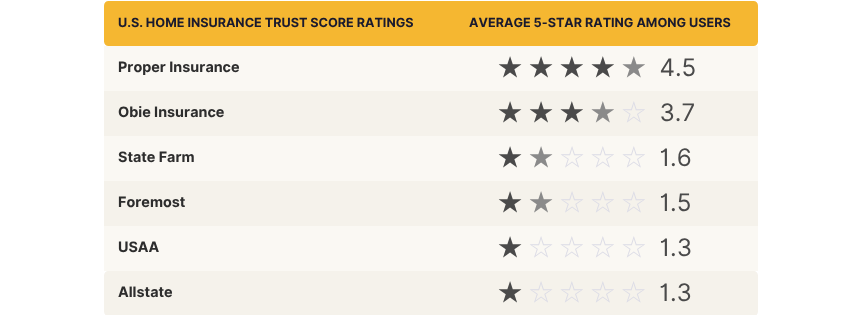
Note: The above review graphic is based on Trustpilot review ratings as of July 2026.
Trustpilot’s U.S. Home Insurance Carriers TrustScore Ratings
Real-Life Host Tragedies Avoided With Loss of Business Income Coverage
Look no further than Gatlinburg, TN, where there was a historic fire in 2016 that destroyed 2,500 structures, and again in 2022 where another 350 vacation homes were lost. In fact, Proper insured properties were lost in that fire, and our claims team was on scene, pictured below. The Proper policy provides business income coverage, with an actual loss sustained valuation, and no time limit; it’s only subject to the limits an insured chooses. This means we pay insureds what they actually lose in business income after a covered property loss, with no time limit: payments continue until repairs are complete or the selected limit is used up, whichever comes first.
Change block type or style
Move Columns block from position 9 up to position 8
Move Columns block from position 9 down to position 10
Change alignment
Unfortunately, many of the property owners in these TN fires carried what’s called additional living expense or loss of rents with fair market value, which both typically carry a 12-month cap. This means an insured is only paid the fair value of lost rents, and the payments stop coming after 12 months. Rebuilding after a total fire loss can take two years or more, and vacation rentals earn far more than long-term rentals, so a 12-month, fair-market payout can fall well short. Most property owners don’t ever imagine a total fire loss, but if it happens, your insurance coverage reimbursement lies in the details.







Latest
Resources

What Insurance Do You Need for Different Short-Term Rental Situations?

New Airbnb Hosts’ Guide for 2026

Airbnb Superhost vs Guest Favorite: What’s the Difference?
