
Proper’s Business Revenue Coverage for Short-Term Rentals
The coverage gap of lost income is where most short-term rental owners get blindsided. Standard Homeowners and Landlord policies don’t insure business income: Homeowners has no income coverage, and Landlord policies carry loss of rents instead. Airbnb AirCover ties income only to guest-caused damage.
The Proper Policy has Business Revenue Coverage as part of our commercial-grade short-term rental policy. It covers your actual loss sustained—the real rental revenue you would have earned during the period of restoration—with no arbitrary time cap and up to the limit you choose.
Your short-term rental is a business. When a covered loss forces it offline, your revenue shouldn’t have to go with it.
What Is Loss of Business Income Coverage?
Loss of business income insurance—also called business interruption insurance—replaces the income your short-term rental would have earned if a covered loss hadn’t forced it offline.
For short-term rental owners, the concept is straightforward: a covered incident renders your property uninhabitable or unrentable, and your policy steps in to replace the vacation rental income you would have collected during the time it takes to restore the property.
Running Faucet: A $30,000 Loss of Business Income Claim
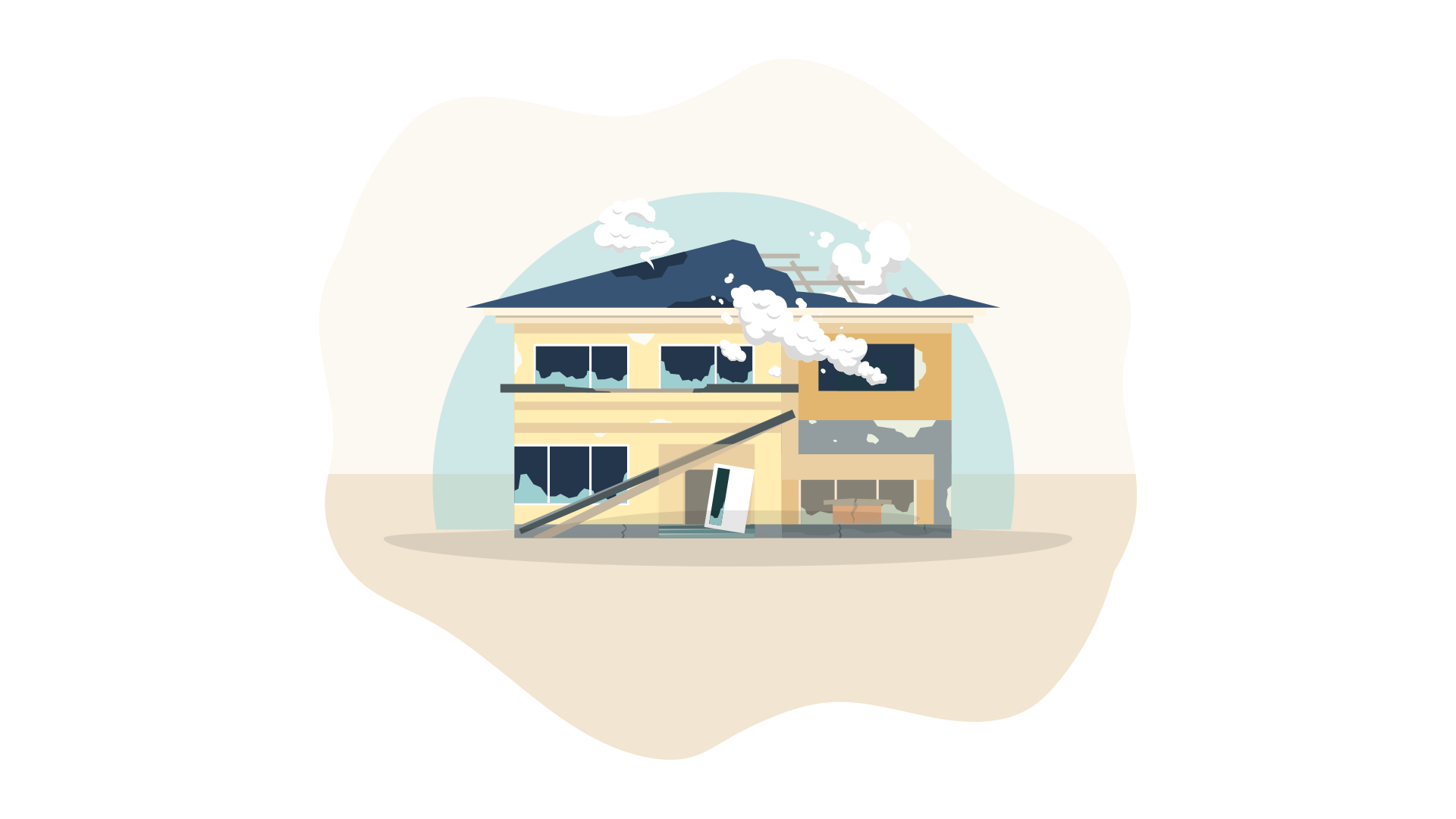
When a guest left a faucet running during a power outage, Jason’s highly rated STR flooded from the main floor to the finished basement below.
Proper’s Business Revenue Coverage calculated his lost income using historical and seasonal data, paying out the high-season revenue he couldn’t earn during the rebuild.
| Water Damage Claim | Amount |
|---|---|
| Covered Damage | $100,000 |
| Business Income | $30,000 |
| Total Claim Paid | $130,000 |
Burst Pipe: $117,000 in Lost Income. 5x the Damage Itself.
This coverage matters because repairing the building is only part of the financial toll of a covered damage claim. While contractors are working, your bookings are canceled, your calendar is empty, and your fixed expenses keep running. For many hosts, the revenue lost during the repair period exceeds the cost of the physical damage itself—especially when a loss hits during peak season.
Take, for example, a burst pipe that forced a Colorado ski home offline mid-season; the property damage came to $23,000. The lost booking revenue during repairs totaled $117,000—five times the cost of the physical damage itself.
| Single Family Home | Amount |
|---|---|
| Covered Damage | $23,000 |
| Business Income | $117,000 |
| Total Claim Paid | $140,000 |
Why Business Income Coverage Is Critical for STR Owners
Short-term rentals aren’t passive properties, they’re businesses with variable nightly rates, seasonal demand, and income that changes week to week. Standard insurance products weren’t built for that operating reality, and most hosts don’t discover the gap until they file a claim and find out their Homeowners or Landlord policy doesn’t cover lost income at all — or bases the payout on a “loss of rents” calculation that significantly underestimates what their STR actually earned.
When a covered loss sidelines your rental, the question isn’t simply “Is the building covered?” It should also be “Is my revenue covered?” For short-term rental owners, those are two very different questions.
The Proper Policy: What is Business Revenue Coverage?
Actual Loss Sustained—Not an Estimate
Most income coverage in standard commercial policies calculates your loss based on net income—what’s left after operating expenses are deducted. The Proper Policy’s Business Income coverage is calculated on actual loss sustained: the gross revenue your rental would have earned, calculated against your real booking history and calendar at the time of loss—not a flat daily rate, not a net-income estimate with expenses stripped out. For a short-term rental with peak-season bookings, this is the difference that matters most.
No Time Limit on the Period of Restoration
Some business interruption policies have a timeframe cap on their coverage regardless of how long repairs actually take. Business Income coverage on the Proper Policy runs through the actual period of restoration: the time reasonably required to repair or rebuild your property and return it to rentable condition. No artificial cutoff. Coverage ends when the work is done and your property is once again available to be booked.
Coverage Tied to Real Booking Revenue
Short-term rental income is variable. A two-month closure in July doesn’t cost the same as a two-month closure in February. The Proper Policy uses your actual revenue profile (seasonal rates, confirmed bookings, and earning history), rather than applying an average amount based on all rentals in your area—which ignores how your property actually generates income.
Integrated with Property Coverage
Business revenue loss doesn’t happen in isolation—it’s triggered by a covered property claim. The Proper Policy is built as a standalone commercial policy, so when a guest causes significant damage or a fire incident forces your property offline, your revenue coverage activates as part of the same claim—not as a separate policy you have to chase.
Coverage Up to the Limit You Choose
The Proper Policy’s Business Revenue Coverage is set at a limit you select when building your policy—sized to your property’s actual earning capacity and the needs of your short-term rental business model.
In-House Claims Handling
Business revenue claims are handled by Proper’s in-house claims team—the same team that handles your property and liability claims. One point of contact, one claims process, no runaround between separate carriers or departments.
Why “Loss Of” Coverage Matters for Short-Term Rental Owners
Your short-term rental isn’t just a property, it’s a business, which means every booking represents revenue. Every canceled stay—whether forced by fire, a guest trashing the place, or a sneaky water damage claim that drags on for weeks—is income lost. For Airbnb hosts and vacation rental owners, downtime can mean a direct hit to your bottom line. That’s what makes loss of business income coverage one of the most important components of any short-term rental insurance policy.
Airbnb Host FAQ: Won’t my Landlord Insurance Cover Lost Short-Term Rental Revenue?
In most cases, no. Landlord insurance policies typically include Loss of Rents coverage, which is calculated based on Fair Rental Value: an average of all comparable rentals in your area, long-term rentals included. For a short-term rental generating nightly rates well above what a long-term tenant pays for monthly rent, that calculation falls significantly short of your actual lost revenue.
Airbnbs and vacation rentals operate with constant guest turnover and booking-based revenue, meaning that a single covered loss can take a property offline for weeks, months or even a year plus—and mortgages, bills, and expenses don’t stop during this time. Proper’s Loss of Business Income coverage helps keep your revenue stream going while your property is offline during covered repairs.
Loss of Business Income vs. Loss of Rents: A Critical Distinction
Most hosts assume their short-term rental’s coverage handles Loss of Income. Standard Homeowners policies weren’t written for properties that run like a business, which means they don’t protect income—and can terminate a policy entirely for undisclosed short-term rental activity. A home-sharing rider may address the cancellation risk, but it doesn’t solve the income problem: loss of use coverage, when included at all, calculates your payout at long-term rental rates, not what your STR actually earns.
Loss of use, loss of rents, and loss of business income coverage sound interchangeable—but they’re not—and for short-term rental owners, the difference shows directly on the claim check.
Loss of Use is a Homeowners coverage that helps pay for additional living expenses when an owner-occupied home becomes uninhabitable after a covered loss. A home-sharing endorsement may help address some short-term rental exposures, but Loss of Use coverage is designed to protect the homeowner’s living arrangements—not replace the revenue generated by a short-term rental business.
Loss of Rents is a Landlord coverage designed to replace the fixed monthly rent a landlord loses when a property is temporarily unlivable. The loss of rents coverage calculation is based on the Fair Market Rental Value (also known as Fair Market Loss of Rents) of similar properties in the area and is designed for traditional long-term rentals. For short-term rental hosts, this can create a significant gap between what the property was actually earning as an Airbnb and what the policy can pay after a covered claim.
Loss of Business Income is a Commercial coverage that replaces the income a business loses when a covered loss forces it offline. For short-term rentals, The Proper Policy calculates that loss using gross booking revenue—the full amount you would have earned—not net income after expenses. Commercial-level business income coverage built for short-term rental hosts is rare. That’s why Proper Insurance created a custom Commercial Homeowners policy with Business Income coverage as its foundation.
| Coverage | The Proper Policy: Loss of Business Income | Homeowners Policy (HO): Loss of Use | Landlord Policy (DP): Loss of Rents |
|---|---|---|---|
| Designed for | Operating businesses | Homeowners in owner-occupied properties | Long-term landlords |
| Calculates loss as | Gross revenue (actual bookings lost) | Living expenses (lodging during a covered loss) | Net income (after expenses) |
| Revenue basis | Variable nightly rate | None | Fixed monthly rent |
| Accounts for seasonality | Yes | No | No |
| Standard policy type | Commercial or a custom-built Commercial Homeowners policy from Proper Insurance | Homeowners policy with an endorsement | Homeowners / Landlord (DP) |
| Fit for STRs | Purpose-built | Not at all | No—has loss of rents, not business income |
A standard Landlord policy, for example, would calculate your payout based on what comparable rentals in your area charges per month including mid-term and long-term rentals—not your actual nightly rate. Whereas a Homeowners policy with a rider or endorsement offers no real income protection, only living expenses. If your two-bedroom short-term rental generates 2–3x what the neighbor’s long-term rental earns, you’re absorbing that difference out of pocket.
What Triggers Business Revenue Coverage for Vacation Rentals
Understanding what activates coverage helps set realistic expectations and avoid surprises at claim time. Business Revenue coverage is activated by a covered loss tied to a property event.
Loss of Business Revenue Coverage is Triggered By A Covered Loss Such As:
- Fire, smoke, or water damage that renders the property uninhabitable
- Guest-caused damage that forces closure for repairs (covered under property entrustment
- Bed bug or flea infestations where Proper’s policy includes revenue coverage
- Squatter situations where the property cannot be rented due to the damage left behind
For a deeper look at what triggers coverage, read The Importance of Loss of Business Income for Your Short-Term Rental.
Why Standard Policies Fall Short for STR Revenue
These aren’t edge cases or fine-print exclusions, they’re the default. Most standard policies weren’t built for properties that operate like businesses, and the gaps show directly on the claim check. What business interruption insurance covers at the commercial level is exactly what’s missing from a standard Homeowners or Landlord policy when a vacation rental goes offline.
| Coverage | The Proper Policy: Loss of Business Income | Homeowners Insurance (HO) |
HO + Home-Sharing Endorsement |
Landlord Insurance (DP) |
Airbnb AirCover |
|---|---|---|---|---|---|
| Business income coverage | Included | Excluded | Limited or excluded | Excluded | Not covered |
| Actual loss sustained basis | Yes | N/A | Fair market loss of rents | Fair market loss of rents | N/A |
| Covers peak-season revenue | Yes | No | No | No | No |
| No time cap on restoration period | Yes | N/A | Often capped | Often capped | N/A |
| Triggered by guest-caused damage | Yes | Case-by-case | Case-by-case | Case-by-case | Case-by-case |
Real Review of Proper’s Coverage & Claims
“Proper Insurance provided outstanding support on a complex short-term rental claim that included multiple income streams and business income coverage. The claims team was professional, responsive, and thorough throughout the process…The claim was handled fairly and approved as expected, and I felt well supported from start to finish. I would confidently recommend Proper Insurance to other short-term rental owners looking for knowledgeable coverage and strong claims support.”
-Priscila R.
Secure Your Short-Term Rental Income with Proper’s Business Revenue Coverage
Your property represents real, ongoing revenue. A covered loss shouldn’t mean absorbing weeks or months of income loss on top of everything else. Proper’s Business Revenue Coverage is built for how short-term rentals actually generate income—because when you’ve built a business around your property, your insurance should protect the business, not just the building.
Frequently Asked Questions: Business Revenue Coverage for Short-Term Rentals
What is the difference between loss of business income and loss of rents?
Loss of rents is a Landlord coverage that replaces net rental income—fixed monthly rent, minus ongoing expenses—when a property is temporarily unrentable. Loss of business income is a Commercial coverage that replaces gross revenue—the actual booking income a business would have earned. For short-term rentals, which generate variable income based on nightly rates and booking volume, business revenue coverage is the appropriate tool. Loss of rents consistently underestimates what an STR owner actually loses.
Does Proper’s Business Revenue coverage have a time limit?
No. Proper’s coverage runs through the actual period of restoration—the time reasonably required to repair or rebuild your property and return it to rentable condition. Some policies cap income coverage at 30 or 60 days regardless of actual repair timelines. Proper’s doesn’t—The Proper Policy is based on the lost revenue amount you choose.
What does “Actual Loss Sustained” mean for my Airbnb?
“Actual Loss Sustained” means your coverage is calculated based on what your rental business would have genuinely earned during the restoration period—using your booking history, confirmed reservations, seasonal rates, and actual earning capacity at the time of loss. It’s not a flat daily rate or a net-income estimate. For hosts with significant peak-season revenue, this distinction can mean thousands of dollars on a covered claim.
How do I document my business revenue for a claim?
The most useful documentation includes your booking history from Airbnb, Vrbo, or your direct booking platform; confirmed reservations during the repair period; and any forward pricing data that reflects your nightly rates at the time of loss. If historical data isn’t available, carriers of The Proper Policy still have Lost Business Revenue protection after a covered loss. Proper’s in-house claims team will guide you through the documentation process when a claim is filed.
Can I choose how much Business Revenue coverage I carry?
Yes. Proper’s Business Revenue Coverage is set at a limit you select when building your policy. Your Proper agent can help you size that limit to your property’s actual earning capacity—based on your booking volume, nightly rate, and seasonal revenue profile. We recommend 12-24 months of revenue coverage.
How is business income calculated for an insurance claim?
For short-term rentals, business income is typically calculated as average daily rate × occupancy × days offline, adjusted for confirmed bookings and seasonal demand at the time of loss. Proper’s in-house claims team handles this using your actual booking history or comparable short-term rental properties in your area if you are a new host—not a market average.
Latest
Resources

Can I Be an Airbnb Host in South Carolina? What Hosting Actually Requires in 2026

Cold-Season Success: Prepare Your Short-Term Rental for Winter

Airbnb’s AirCover Protection: What It Covers (and Why It’s Not Insurance)
