
Airbnb’s AirCover Protection: What It Covers (and Why It’s Not Insurance)

Airbnb’s AirCover protection does not replace a host’s current Homeowners insurance, and it isn’t a substitute for a dedicated short-term rental policy like Proper Insurance. Many hosts still assume AirCover functions like a complete insurance solution when it does not.
If you are still wondering what Airbnb AirCover actually covers—and whether it’s enough to protect your short-term rental—you’re not alone. Let’s review Airbnb’s Host Damage Protection, Host Liability Insurance, and the biggest gaps hosts need to understand before relying on platform protection alone.
- What Does Airbnb AirCover Actually Cover?
- Why is AirCover Recommending You Call Your Insurance Company?
- What Airbnb AirCover Does NOT Cover Reliably
- Will Airbnb’s AirCover Protection be There When You Need Property Coverage? Read Real Reviews of AirCover
- AirCover vs. Real Short-Term Rental Insurance: Is AirCover Enough Insurance for Hosts?
- Frequently Asked Questions About AirCover and Short-Term Rental Insurance

TL;DR: Do I need insurance for Airbnb? Yes. AirCover is not a substitute for your own insurance, it’s Airbnb’s supplemental protection program, not a policy that covers your property, your liability, or your income. Airbnb itself advises hosts to confirm how, or whether, their existing insurance applies to short-term rental activity. Hosts who rely on AirCover alone risk denied claims, uncovered property damage, and liability exposure that a dedicated Airbnb host insurance policy is built to prevent.
What Does Airbnb AirCover Actually Cover?
Most hosts are asking: What does AirCover include, and is AirCover worth it? In simple terms, AirCover may respond to some property damage, some liability claims, and some host-adjacent risks—but only under Airbnb’s rules, deadlines, exclusions, and claims procedures.
Airbnb’s AirCover for Hosts consists of two very different protections:
(1) Host Damage Protection: Up to $3 million in coverage (not insurance)
(2) Host Liability Insurance: Up to $1 million in coverage (insurance, but not your insurance)
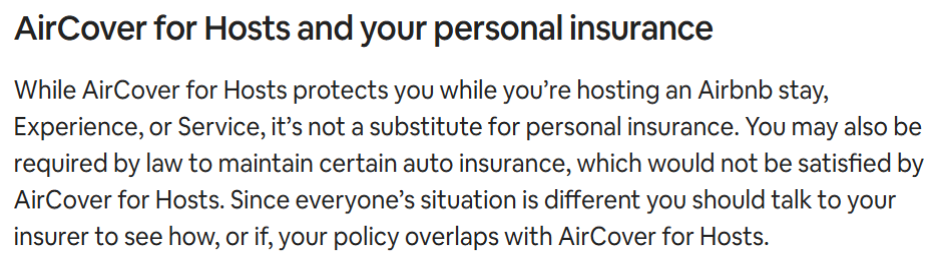
As stated on their own website, Airbnb is not an insurance policy. While it offers some protection during Airbnb stays, hosts are still responsible for maintaining their own insurance coverage and should confirm how, or if, their existing policy applies to short-term rental activity. Airbnb’s coverage options are very different from having your own insurance policy. With your own policy, your insurer is bound by contract to work for you—with AirCover, Airbnb sets the terms, manages the process, and makes the call.
Does AirCover Actually Protect You?
A free guide to what Airbnb’s AirCover really covers—including why regulators are now challenging its $3 million damage guarantee as unlicensed insurance.
Why is AirCover Recommending You Call Your Insurance Company?
If you do not fully disclose your Airbnb rental activity to your insurance provider, then they can virtually deny any insurance claim, even ones that are unrelated to your Airbnb business. There have been multiple lawsuits where homeowners had claims denied after insurers discovered undisclosed short-term rental activity—sometimes even when the damage wasn’t caused by a guest. In response, many insurers introduced ‘home-sharing endorsements’ to avoid litigation. What you truly need is a comprehensive Airbnb Homeowners insurance policy.
There is also a misunderstanding in the short-term rental industry that a property owner can simply purchase a standard Homeowners policy and then rely on Airbnb’s Aircover to protect the property while it’s being rented. This couldn’t be further from the truth.
As an Airbnb, your property is regularly being used by guests, and these guests are unfamiliar with the property.
- They may not know where the water shut-off valve is in the event of a broken water pipe, which can lead to unnecessary water damage claims.
- They may not know how to properly use the fireplace, which can lead to a fire claim.
- They may not know the kitchen breaker often pops when you use the microwave and fan at the same time, which leads them to fiddle with the property’s wiring and a future fire claim.
- They may not know where the light is to use the back stairs, which could lead to a serious injury and liability claim.
- They may not lock the back door, which could lead to a burglary or theft claim.
- The list goes on…
Basically, guests do not take the same care of a property as a homeowner would. Plus, many property owners look at short-term rentals as investments, not their primary homes or residences, which leads to more maintenance issues and eventual insurance claims. In March 2026, the Insurance Information Institute confirmed what the STR industry has long ignored: standard Homeowners insurance typically does not cover Commercial activities, including renting out a property on a short-term basis.
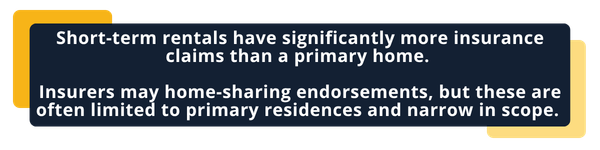
“Why fix the roof, it’s only a rental!” When you add all this up, you get significantly more insurance claims at short-term rental properties than you do at a primary home or residence. While many insurers now offer home-sharing endorsements, these are often limited to primary residences and narrow in scope.
What hosts really need is a policy designed to replace standard Homeowners coverage for short-term rental use, such as The Proper Policy, a unique Commercial Homeowners policy built specifically for short-term rental owners and Airbnb Hosts.
What Airbnb AirCover Does NOT Cover Reliably
While AirCover includes certain protections, there are important gaps hosts should understand. AirCover may not cover losses outside Airbnb’s claim filing deadlines and documentation requirements, or claims that fall within the platform’s long list of exclusions, which Airbnb notes isn’t even the full list of exclusions.
Plus, if the Airbnb claim happens outside of the booking window, AirCover will not step in. In practice, many of the most common and costly host risks fall into gray areas where coverage may be limited—or denied.
In some cases, AirCover may not act as your primary coverage at all. Announced in March 2025, hosts with six or more active Airbnb listings may see AirCover apply only as excess coverage, meaning it only responds after other insurance policies are exhausted. This makes it critical to understand how your personal or Commercial insurance policy interacts with AirCover before relying on it for protection.

Will Airbnb’s AirCover Protection be There When You Need Property Coverage? Read Real Reviews of AirCover
Since the AirCover Host Damage Protection is simply a rebrand of the Airbnb Host Guarantee, we do have some history to look at. A recent is example is a $1 million home that burned down while guests were on a hike—and Airbnb won’t cover it.
Then, a deeper look reveals some pretty terrible reviews of Airbnb’s AirCover insurance:
Trustpilot: 16,219 Reviews, 1.3/5
“All hosts pay attention; this garbage bucket shop of a company claims to have insurance, but trust me, from my personal experience, you are NOT insured, and if a guest makes damage to your property, they will just respond, unfortunately, your request has been denied.”
Better Business Bureau: 7,621 Complaints, 1.05/5
“AirBnB touts they provide guest damage protection, but when there is damage like a broken floor tile, doors severely scratched up, floors with deep gouges in them, they say it’s considered Normal Wear and Tear and not covered. I’m not sure in what World these damages would be considered Normal.”
Consumer Affairs: 2,571 Reviews, 3.6/5
“The last guest that I had almost destroyed my property. Damage to my artwork. Dirt and disgusting stuff were everywhere. Broken plates, cups, and a big window of a French door which took me 4 days to replace. Party every night till dawn, disturbed the neighbors, and Airbnb did not take any responsibility. Shame on them.”
AirCover Reddit Thread – $2000 damage, $15 Reimbursement”
“The story could be mine exactly. Airbnb has no interest in anything but their own bottom line. Get your own insurance!!!!!”
There is some evidence of Airbnb paying out for damage, but it’s pretty hard to ignore all these negative comments. It’s right in the policy language: damage protection is not insurance, and the list of what Airbnb doesn’t cover is much longer than the list of what is covered. At best, AirCover should be thought of as a back-up to a back-up—not a reliable safety net.
Even so, hosts can’t forget that AirCover’s damage protection generally won’t respond until after they’ve exhausted the time, resources, and finances Airbnb deems necessary, submitted documentation Airbnb views as sufficient, and met strict filing deadlines.
AirCover vs. Real Short-Term Rental Insurance: Is AirCover Enough Insurance for Hosts?
AirCover is a platform protection designed to support Airbnb. Short-term rental insurance is a policy designed to protect the host.
With AirCover, Airbnb controls the claim. With insurance, you are the policyholder. With AirCover, coverage is conditional. With insurance, coverage is defined by contract. That distinction is what separates a guarantee program from real protection.
Airbnb AirCover may help in certain situations, but it is not a substitute for real insurance. If you rely on it alone, you risk coverage gaps, denied claims, limited recourse, and significant financial exposure. For hosts who want full protection, the better approach is a policy specifically designed for short-term rentals—one that names you as the insured and is built to protect your property, liability, and income.
Please note that the snapshots and review links included here were taken from Airbnb when the blog was written on June 30, 2026. Airbnb updates policies and content frequently; specific language may have changed. The same is true for third-party reviews, program summaries, and policy-related help pages referenced on this page.
Frequently Asked Questions About AirCover and Short-Term Rental Insurance
Is AirCover worth it?
In short: No, AirCover’s free services are not worth the risk. While free coverage sounds appealing, AirCover’s exclusions and lack of policy rights leave hosts vulnerable. For true peace of mind, you need a dedicated short-term rental policy that covers property, liability, and lost income.
Do I need insurance if Airbnb provides AirCover?
Yes. AirCover doesn’t remove the need for your own policy — it’s a supplemental protection, not a replacement. Airbnb itself advises hosts to confirm how, or if, their existing insurance applies to short-term rental activity. Relying on AirCover alone risks coverage gaps, denied claims, and financial exposure that a dedicated STR policy is built to prevent.
Is Homeowners insurance enough for Airbnb?
No. Standard Homeowners insurance is built for personal, non-Commercial use. The Insurance Information Institute confirmed in March 2026 that standard Homeowners policies typically don’t cover Commercial activities, including short-term renting. Hosts who don’t disclose Airbnb activity to their insurer also risk having claims denied—even ones unrelated to a guest stay.
What does AirCover not cover?
AirCover has two parts: Host Damage Protection (up to $3 million, not insurance) and Host Liability Insurance (up to $1 million — insurance, but not a policy in the host’s name). Both carry exclusions Airbnb acknowledges aren’t fully published. AirCover typically won’t respond to claims filed past its deadlines, damage outside the booking window, or losses that fall into its exclusion list. Hosts with six or more active listings may also see AirCover apply only as excess coverage, after other insurance is exhausted.
Does AirCover replace short-term rental insurance?
No. AirCover is Airbnb’s platform protection program, not an insurance policy. Airbnb states directly that AirCover isn’t insurance, and hosts remain responsible for their own coverage. The core difference: with insurance, you’re the policyholder and coverage is defined by contract. With AirCover, Airbnb controls the claim and coverage is conditional.
Is hosting an Airbnb worth it?
Hosting can be profitable, but only if you understand the risks. AirCover alone won’t protect your income or assets. AirCover helps with guest‑related incidents tied to Airbnb stays, yet major gaps remain. Airbnb itself advises that AirCover is not a replacement for personal or commercial insurance. Without comprehensive short-term rental insurance, a single incident—like a guest injury or major property damage—could wipe out years of earnings.
What kind of insurance do I need for my Airbnb?
Most hosts need a dedicated short-term rental insurance policy rather than a standard Homeowners or Landlord policy. A true STR policy is written to cover guest-caused property damage, liability for guest injuries, and lost rental income — risks that AirCover and typical home-sharing endorsements leave only partially addressed.