
Does Airbnb Provide Liability Insurance? What Every Host Needs to Know
Airbnb provides a form of liability insurance—but not the kind that names you as the policyholder. AirCover includes $1 million in Host Liability Insurance, but it can give hosts a false sense of security, as under Airbnb’s policy they are not the named insured. That means Airbnb controls whether your claim gets paid. Understanding that distinction could be the difference between being protected and being exposed when a guest gets hurt.
This page focuses specifically on the liability side of AirCover—what Airbnb liability insurance for hosts covers, what it excludes, and why hosts who want real liability protection need a policy with their name on it.
- What Airbnb's Host Liability Insurance Actually Is
- Who Pays If a Guest Is Injured at Your Airbnb?
- Does Airbnb Host Protection Insurance Actually Cover What Hosts Need?
- Airbnb Liability Coverage: Why the Host Protection Plan Falls Short
- Airbnb Host Insurance vs. Dedicated Short-Term Rental Insurance
- Does Renters Insurance Cover Airbnb Liability?
- The Best Liability Protection for Airbnb Hosts Is a Policy With Your Name On It
- Frequently Asked Questions About Airbnb Host Liability Insurance
- Verify Your Insurance is Enough for Your Airbnb Operation

Key Takeaways: Airbnb’s AirCover includes $1 million in Host Liability Insurance, but hosts under Airbnb’s policy are not the named insured. Airbnb decides whether to respond to a claim on your behalf.
AirCover excludes assault and battery, off-premises incidents, and injuries outside of the booking window, and in the United States, the program is underwritten by a non-admitted insurer not subject to your state’s insurance laws. Real liability protection means a policy with your name on it, where your insurer is bound by contract to defend you.
What Airbnb’s Host Liability Insurance Actually Is
AirCover for Hosts consists of two very different protections. Host Damage Protection covers property damage—but it is not insurance. Host Liability Insurance is insurance—but it is Airbnb’s policy, not yours.
This page is about the liability side. For a full breakdown of the property damage side, see our guide to Airbnb Host Damage Protection. For a complete top-to-bottom examination of both parts of AirCover, see our Airbnb AirCover protection overview.
The critical thing to understand about AirCover’s Host Liability Insurance is that hosts are not individual policyholders—they’re covered under Airbnb’s master liability policy. Airbnb arranges and controls that policy, and coverage is automatically applied to bookings rather than something a host owns or manages directly.
Hosts cannot modify the policy, negotiate terms, or control how it’s administered. When a liability claim is filed, it’s reviewed and resolved by Airbnb’s third-party insurance provider according to the policy terms—not by the host.
In practice, that means hosts depend entirely on Airbnb’s program structure and the insurer’s interpretation of coverage when a claim is made.
Who Pays If a Guest Is Injured at Your Airbnb?
Airbnb AirCover is broken into two parts: property protection, which is not insurance, and Host Liability Insurance, which is insurance—but Airbnb’s. The underwriter (Generali US Branch) issues the policy to Airbnb, not to hosts. That makes Airbnb the policyholder and leaves hosts with limited rights—no policy control, no guaranteed coverage, and complete dependence on Airbnb to respond to a claim on your behalf.
AirCover’s Host Liability Insurance covers up to $1 million for certain bodily injury and third-party property damage claims. Hosts, co-hosts, property managers, and cleaners may be included—but the coverage only applies during an Airbnb stay, only for bookings made through the Airbnb platform, and only if Airbnb determines the claim qualifies. Even Airbnb’s own program summary acknowledges the exclusion list is not complete.
In most cases, the host is legally responsible if a guest is injured due to unsafe conditions on the property. This is known as premises liability for Airbnb hosts. If you’re found at fault, you may be sued directly for medical bills, legal fees, and financial compensation. Airbnb’s Host Liability Insurance may provide coverage—but only if certain conditions are met, and many claims fall into the gaps. There are also very few publicly documented examples of hosts successfully receiving a payout under the $1 million coverage, making it difficult to evaluate how the program actually performs.
Hosts need a liability insurance policy with their name on it. For hosts who want liability protection where they are the policyholder, get the best Airbnb insurance available.
Does Airbnb Host Protection Insurance Actually Cover What Hosts Need?
When hosts first list their property, the way Airbnb markets AirCover is attractive—it’s free, appears to offer significant coverage, and it’s built for hosts. But relying on Airbnb’s host protection insurance for liability is not a gamble any short-term rental host should make.

Airbnb Liability Coverage: Why the Host Protection Plan Falls Short
The Airbnb Host Protection Insurance has numerous problems with it that could leave you exposed and vulnerable to certain liability issues. For example, did you know that Airbnb’s plan does not cover malicious damage or assault? These are serious issues that every business owner should be insured against. Plus, Airbnb’s plan has a low reimbursement cap, which means you could still be paying out of pocket. Even worse, the plan has so many exclusions and requirements, that it makes it difficult to receive coverage at all!
What Airbnb’s Host Liability Insurance Excludes
Airbnb’s Host Liability Insurance does not cover assault and battery on your premises. It does not cover off-premises incidents—meaning if a guest is injured away from your property in a situation that traces back to your rental, you’re on your own. It does not cover injuries that occur between bookings, and it does not cover communicable disease transmission, electronic data loss, or certain contractual liability claims. These are not edge cases—they are the kinds of incidents that generate the largest legal exposure for hospitality businesses.
There’s also a structural limitation most hosts don’t know about. Effective March 1, 2025, hosts with six or more active Airbnb listings may see AirCover apply only as excess coverage—meaning it only responds after other insurance policies are exhausted first. For multi-property hosts, AirCover is explicitly a backup, not a primary protection.
And in the United States, Airbnb’s own program summary discloses that in certain instances, the HLI program is underwritten by a non-admitted insurer—meaning it may not be subject to your state’s insurance laws and regulations and is not protected by your state’s insolvency guaranty fund. For hosts pursuing direct bookings or listing on other platforms, that’s not a minor gap — it means a real share of your bookings could carry zero liability protection at all. That’s a material disclosure most hosts never see.
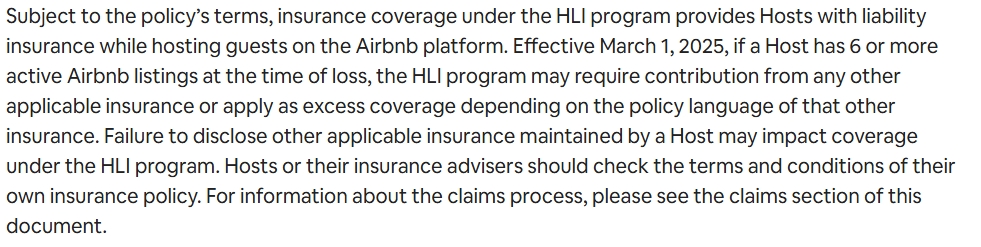
Airbnb themselves don’t recommend relying on AirCover as your only protection—that guidance is buried in the fine print. That’s because the exclusion list—which Airbnb’s own summary acknowledges is incomplete—spans everything from assault and battery to off-premises injuries to communicable disease, while the coverage itself is limited to a single narrow scenario. If your liability incident falls outside the specific criteria Airbnb has set, you could be paying out of pocket entirely—for medical bills, legal defense, and any judgment against you.
Whether you rent out your property once a year or you’re a full-time property manager, adequate liability coverage is critical. AirCover is not it.
Airbnb Host Insurance vs. Dedicated Short-Term Rental Insurance
The difference between Airbnb’s Host Liability Insurance and a dedicated short-term rental insurance policy comes down to one question: whose side is the insurer on?
With AirCover, Airbnb controls the claim. Airbnb sets the terms, manages the process, and makes the final call on whether liability coverage applies. Hosts are insured under Airbnb’s master liability policy, rather than being the primary policyholder themselves—which means you have no policy control and no guaranteed right to coverage. There is no independent claims adjuster working on your behalf, and in the United States, no state insurance commissioner is required to oversee the program.
With a dedicated short-term rental insurance policy, you are the named insured. Your insurer is bound by contract to work for you. If a guest is injured on your property and files a liability claim, your insurer provides legal defense, covers medical bills up to your policy limit, and is regulated by your state’s insurance commissioner. If you dispute a denial, you have rights—including the right to a public adjuster.
AirCover’s liability coverage is also platform-dependent. If a guest books directly or through another OTA and is injured at your property, AirCover’s Host Liability Insurance does not apply. A dedicated STR policy, like the one by Proper Insurance, covers liability across all booking channels—not just Airbnb stays. For hosts pursuing direct bookings or listing on multiple platforms, that gap is not a minor detail—it is a complete absence of liability coverage for a meaningful portion of your stays.
Does Renters Insurance Cover Airbnb Liability?
Generally, no — this comes up most often for rental arbitrage hosts, tenants who carry a renters policy for their long-term lease and assume it extends to subleasing on Airbnb. Most renters insurance policies include a business activity exclusion that voids liability coverage when the insured is generating income from the property. If a guest is injured at your Airbnb and you file a liability claim under your renters insurance policy, the insurer will almost certainly deny it on the grounds that the property was being used for a commercial purpose at the time of the incident.
Some insurers offer limited home-sharing endorsements, but these carry low liability limits—typically far below what a serious guest injury claim could generate—and are restricted to primary residences. They are not a substitute for a dedicated commercial liability insurance policy.
If you list your property on Airbnb and want real liability protection, a renters policy is not the answer. You need a short-term rental policy that names you as the insured and is built for Commercial hosting activity.
The Best Liability Protection for Airbnb Hosts Is a Policy With Your Name On It
Securing a comprehensive policy that specifically covers renting out your property on Airbnb is without question your best bet. Instead of relying on a free platform-provided program and constantly wondering what Airbnb actually covers when a liability claim arises, a dedicated short-term rental policy gives you the legal protections that AirCover simply cannot.
A Proper Insurance policy names you as the insured—which means your insurer is contractually bound to defend you, pay covered liability claims, and be held accountable by your state’s insurance commissioner. The Proper policy covers Commercial General Liability up to $1 million per occurrence and $2 million aggregate, with coverage that extends to assault and battery, off-premises incidents, and injuries between bookings—the specific liability exposures Airbnb’s AirCover does not reliably cover. Beyond liability, a Proper policy also includes property damage and business income coverage—protections that a standalone liability add-on, or AirCover, simply doesn’t offer. You’re covered as a full short-term rental operation, not just against lawsuits.
Beyond core liability, Proper’s Amenity Liability coverage extends to incidents involving guest use of bikes, hot tubs, pools, and golf carts—both on and off your property. Specialty features include Pet & Animal Liability, Bed Bug & Flea Coverage, and Squatters Coverage—protections that AirCover does not offer and key differentiators when it comes to short-term rental liability offered by specialty STR insurance policies.
Proper Insurance is the nation’s leading short-term rental insurance provider, exclusively endorsed by Vrbo, and available in all 50 states and D.C. Give us a call at 888-631-6680 or get a quote today to make sure your short-term rental insurance coverage has your name on it.
Frequently Asked Questions About Airbnb Host Liability Insurance
Does Airbnb provide liability insurance to hosts?
Yes—but not in the way most hosts assume. Airbnb’s AirCover includes $1 million in Host Liability Insurance, but hosts are not the named insured. Airbnb controls whether the coverage responds to a claim. Hosts have limited policy rights, no guaranteed coverage, and in the United States, the program may not be subject to state insurance regulations. It is Airbnb’s insurance policy, not yours.
Is Airbnb’s Host Liability Insurance enough?
For most hosts, no. AirCover’s Host Liability Insurance excludes assault and battery, off-premises incidents, communicable disease, and injuries between bookings. It only applies to Airbnb bookings—direct bookings and other OTAs are not covered. For hosts with six or more listings, it applies only as excess coverage. There are also very few publicly documented examples of hosts successfully receiving a payout under the $1 million coverage.
What does Airbnb’s AirCover not cover for liability?
AirCover’s Host Liability Insurance names several exclusions directly, including assault and battery, communicable disease transmission, electronic data loss, and certain contractual liability claims. Coverage is also scoped narrowly by design — it only applies during an active guest stay and only at the listed property — which means injuries that happen off-premises or between bookings fall outside the policy entirely. Airbnb’s own summary states this list of exclusions is not exhaustive, meaning additional gaps may exist beyond what’s publicly disclosed.
Does renters insurance cover Airbnb liability?
For hosts, generally no. Most renters insurance policies include a business activity exclusion that voids liability coverage when the property is used to generate income. If a guest is injured at your Airbnb and you file a liability claim under a renters policy, the insurer will typically deny it. A dedicated short-term rental insurance policy with commercial liability coverage is the appropriate solution.
What is the difference between Airbnb host insurance and short-term rental insurance for liability?
Airbnb’s AirCover is a platform program where Airbnb is the named insured and controls all liability claims decisions. Short-term rental insurance is a licensed insurance contract where you are the named insured. Your insurer is bound by contract to defend you; your coverage applies to all booking channels, and your rights are protected by state insurance law.
How does Proper Insurance compare to AirCover for liability?
The Proper Insurance policy names you as the insured—not a platform. It covers Commercial General Liability up to $1 million per occurrence and $2 million aggregate, applies to all booking channels, and provides coverage for liability exposures AirCover specifically excludes—assault and battery, off-premises incidents, and injuries between bookings. Specialty features include Amenity Liability, Pet & Animal Liability, and Squatters Coverage. Claims are handled by Proper’s in-house team under state insurance law, not a platform’s Terms of Service.
Verify Your Insurance is Enough for Your Airbnb Operation
If you’re relying on AirCover as your primary liability protection, it’s worth verifying what you actually have. Proper Insurance is the nation’s leading short-term vacation rental insurance provider—with the most comprehensive policy on the market, including commercial liability coverage that names you as the insured and applies across all booking channels.
Call 888-631-6680 to receive a comprehensive coverage comparison.


