
Unpacking the Cost: Is Proper Insurance Worth It for Short-Term Rental Owners?

Insurance is a crucial component of a short-term rental business. Yet not all insurance policies are created equal, especially when it comes to the specific needs of short-term rental owners. But is vacation rental insurance worth it for owners?
Your first thought when comparing policies may be to look at price. It makes sense to think that way, as the marketing from all mega-insurance companies typically follows “switch and save.” But there’s a reason behind the price difference.
The price of a policy is a reflection of the protection (or lack thereof) that it provides for your property, and in the case of a short-term rental, the protection needed for your guests and your business.
You may now be asking, “Do I need a lot of insurance coverage for my short-term rental?”
Our goal is not just to explain the cost but to illustrate the value that Proper Insurance brings to you as a short-term rental property owner or Airbnb/Vrbo host. The Proper Insurance policy replaces Homeowners and Landlord policies, which were built for other uses, with one that is more robust and tailored to a short-term rental. We want you to understand our coverage as an investment so you can decide if it’s worth it for your business.
And if you’d rather hop on a call with an expert instead of reading our blog, please do. We’d love to hear from you. Call us at 888-631-6680 or submit your information to learn more about our comprehensive coverage for your unique vacation rental situation.
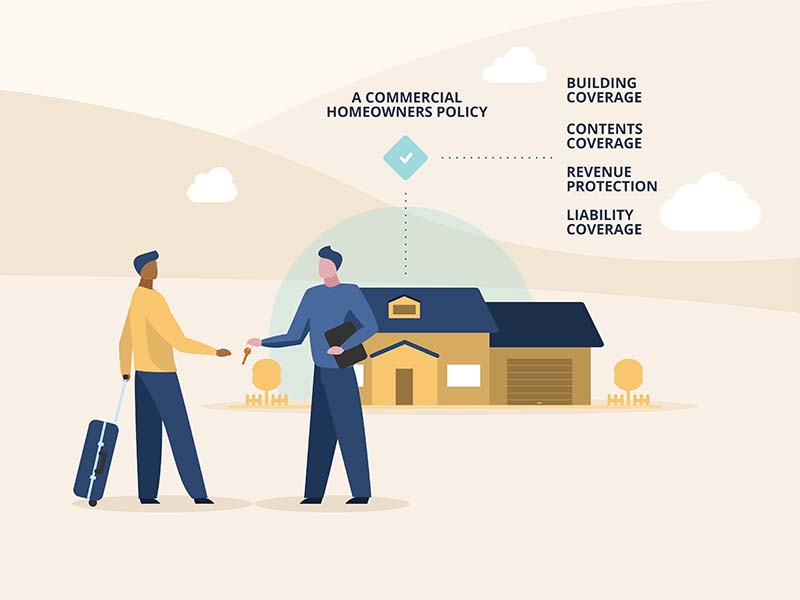
Understanding Your Options: Types of Insurance for Properties
The primary determinant of your insurance cost is the type of coverage you choose. Every home, townhouse, condo, or apartment, whether it’s a short-term rental or not, carries two types of insurance: property insurance and liability insurance.
Property Insurance
Property Insurance encompasses physical damage to your property, which could be the building itself or the contents within, think of it as anything you can touch and feel. This also includes the income that the property generates.
Comparison Between Basic, Broad, and Special Form Coverage for Property Insurance
The three types of property insurance coverage (this applies to building and contents) are:
Basic Form Coverage might be the most affordable option, but it offers the most limited protection, covering only 11 specific perils (risks) listed in the policy. If a damaging incident isn’t among these listed perils (risks), you won’t have any coverage for the incident.
Broad Form Coverage provides a wider scope of protection, covering the 11 perils mentioned in basic form coverage, along with an additional five perils. This means you have coverage against a total of 16 named perils, offering more comprehensive protection than basic form coverage.
The most extensive and therefore most expensive is Special Form Coverage. It operates on an “all-risk” basis, meaning it covers all incidents unless specifically excluded in the policy. This gives you peace of mind, knowing that you’re covered unless the damage is due to a listed exclusion.
Proper Insurance writes Special Form coverage on short-term rental buildings and contents.
Business Income Coverage Explained
As we outlined, the first component of property insurance is the coverage you select for your building and your contents (basic, broad, and special). The second component of property insurance is the income that the property generates.
This is important to understand for short-term rental owners who use a property as an income-generating business. If you have a claim that makes your property uninhabitable for a certain time, you will want to make sure you have this coverage. While your property can’t be rented you will still have a mortgage to pay and bills stacking up.
Loss of rents pays a fair-market long-term rent—a different coverage, not a lower tier of Business Income.
- The amount you receive for fair rental value will be based on all rental properties in your area. This includes long-term rentals and short-term rentals. This is a big issue for short-term rental owners because if you are in peak season for your beach home or mountain cabin, the amount of money a short-term rental generates vs. a long-term rental is drastically different.
- Fair rental value is generally capped at 12 months of lost rental income. So, if you have a devasting wildfire and your property has to be completely rebuilt, the process can take 18 to 24 months until it is operational again. That means after 12 months, no matter how long it takes to rebuild your home, you are losing money.
Business Income is is written around what your short-term rental actually earns. With Proper Insurance, you select the amount of coverage you’d like for lost rental income during the insurance proposal. We recommend insuring 12 months of your rental income, or 24 months if you can absorb the added premium; the months set the dollar limit, not a time limit.
- If a covered claim prevents you from renting and generating income, Proper Insurance will pay the actual loss sustained, meaning your actual lost rental revenue. We look at your previous bookings and future bookings, or if you don’t have that short-term rental history, we will look at comparable short-term rental properties in your area and pay what you’re losing.
- There’s no carrier-imposed cap on Business Income: it runs until repairs are complete or the limit you chose is reached, whichever comes first.
Proper Insurance provides All-Risk Special Form Coverage for building and contents, as well as Lost Business Revenue, is just one area where our policy shines. Now, let’s explore an equally important area of coverage for short-term rental owners: liability.
Liability Insurance
Liability Insurance safeguards you from potential legal claims resulting from incidents that occur on your property.
Understanding Personal, Premise, and Commercial Liability Insurance
The three primary types of liability insurance are:
Personal Liability Insurance is a typical component of Homeowners insurance, designed for primary residences. Many insurance agents may suggest adding a home sharing endorsement to a Homeowners policy when they hear you mention Airbnb. However, if the property is not your primary residence (where you live and receive your mail), this is the wrong policy and should not be offered to you as an option. And if this is what you currently have, we strongly advise you to call a trusted insurance agent, share your Airbnb or direct booking listing, and explain that this home is not your primary residence. Those details could void your coverage entirely if something were to happen.
Premise Liability Insurance, offered by most of our competitors, covers incidents occurring on the short-term rental property itself. But it has its limitations as it doesn’t extend to off-premises incidents, such as accidents involving amenities like bicycles or watercraft provided by the vacation rental property or if a guest gets hurt/injured while exploring your community. This may be a surprise, but the short-term rental owner can be held liable for accidents that occur off of the property, we’ve seen it happen many times before.
Commercial Liability Insurance is the best fit for short-term rentals and while more costly the additional coverage could save you a lot of money in the event of a claim. It not only covers on-premise incidents but also extends to off-premise situations, including accidents involving amenities and even assault and battery claims. Given its broad scope, it is considered the optimal choice for short-term rental properties.
Commercial General Liability is the coverage offered by Proper Insurance.

Deciphering Liability Coverage Limits and Exclusions
Understanding the coverage limits and exclusions of your liability insurance is just as important as choosing the right type.
The coverage limit refers to the maximum amount your insurance provider will pay for a liability claim. For sufficient protection, Proper Insurance recommends a minimum coverage limit of $1 million per occurrence. Your liability coverage limit would cover things like:
- Carbon monoxide poisoning incident
- A drowning in a backyard swimming pool
- A slip and fall down a rugged rocky area behind a beach vacation home
These things don’t happen every day, but when things go terribly wrong, you will want to have a minimum of $1M in coverage. So, if you have a covered loss and have a $1M coverage limit, and on top of that $250,000 in legal fees, we may provide a net payment of $1.25M even though the settlement was for $1M. To reiterate, legal defense cost is in addition to the coverage limit.
Proper Insurance goes above and beyond here too by additionally including legal defense for our insured who experienced a covered loss.
Exclusions are specific incidents or situations not covered by an insurance policy. It’s important to note that a traditional policy, like a Homeowner or Landlord policy, may have exclusions that you wouldn’t want to see in your short-term rental insurance policy. Proper Insurance’s policy would respond to the following commonly excluded items found on most policies:
- Communicable diseases like hot tub rash, which can get expensive quickly. If your policy excludes communicable disease, you will have to pay out-of-pocket for attorney fees/legal defense, respond to summons and appear in court, and pay medical expenses for the guest.
- Liquor liability is a very common exclusion in standard forms. To our knowledge, all our competitors exclude this. This means that you would have no coverage for any property damage or bodily injury at a vacation rental as a result of a guest and alcohol. With Proper Insurance, you don’t have to worry if you want to leave a bottle of wine as a welcome gift for your guests or if an accidental alcohol stash is discovered by the next guest who has young, curious children.
- Assault & battery is another common exclusion in standard forms, which leaves the owner carrying the cost.
- Sexual molestation or abuse is also excluded on most of our competitor’s policies. However, very sadly, these things do happen at vacation rentals maybe because of a gathering or party, and when they do, everyone is getting sued, including the owner of the home.
- Damage, theft and vandalism by guests: While many policies don’t cover damage, vandalism, or theft by guests, Proper Insurance includes this coverage as standard, protecting owners against these potential losses.
Proper Insurance does not exclude the above items but instead responds to them, once again, making our policy the most comprehensive on the market.
Is Your Airbnb Policy Missing Basic Liability Coverages?
Standard policies exclude or limit crucial liability protection for short-term rental owners. What you need to know before you’re left exposed.

STR Coverage by Proper Insurance: Bells and Whistles
When the Proper Insurance policy was being crafted, we decided to go even further by adding unique endorsements and optional add-ons to bring an even more comprehensive policy to the market, further protecting short-term rental owners against the unique risks and specific challenges the industry presents.
Included Endorsements
Damage Caused by a Guest
One of the standout endorsements in the Proper Insurance policy is coverage for damage caused by guests, whether it’s an accidental mishap or deliberate destruction, with no sub-limit. This level of protection offers peace of mind when handing over the keys to your property to a guest, making it an essential feature for any vacation rental property owner.
Nashville short-term rental host, Brady Mills, unfortunately found out the hard way of what happens when a policy has a “malicious acts” exclusion for a short-term rental. His guest had a raging party and caused $10,000 in damage to his property and $2,000-$3,000 in loss of business income. Mills had assumed that his policy would cover him in a situation like this, but he was wrong. He was left to pay out of pocket for all the expenses accrued because his insurance company didn’t step in to help cover the costs.
Backup of Sewers & Drains
Another endorsement in the Proper Insurance policy is coverage for backups of sewers and drains. Whether it’s a minor overflow or a major backup disaster, this endorsement ensures that as a vacation rental property owner, you’re not saddled with the financial repercussions.
A standard home insurance policy does not cover sewer or drain water backup, but the Proper Insurance policy includes this coverage with no sub-limit. These things do happen, especially at short-term rental properties, like this viral situation that happened to Erika Gemzer, who went from Airbnb Superhost to homeless and in massive debt after a guest left her property with extensive water damage from flushing baby wipes. Standard Home policies and Landlord policies typically have low limits at $1,000 for backups of sewers and drains, and sometimes, they are not covered at all unless you pay extra.
Optional Add-ons
In addition to our standard comprehensive policy, there are additional add-on coverages for bed bugs and fleas, squatters, and equipment breakdown. While these additional coverages are low-cost add-ons with Proper, they provide an invaluable safety net in the face of unexpected incidents while short-term renting.
Switch to a Short-Term Rental Policy
Proper Insurance replaces your Homeowners or Landlord policy with coverage built for a short-term rental.
It may come with a higher price tag, but it carries significant value and protection for vacation rental property owners, and a smooth future claims process. By opting for comprehensive coverage, property owners can transfer the financial risks associated with property damage, liability claims, and lost rental income to us.
Ultimately, the choice of coverage you want for your short-term rental depends on your risk tolerance and the potential financial impact you’re willing to shoulder. Weighing the potential risks and financial implications against the cost of the insurance premium will guide your decision.
If greater peace of mind, comprehensive financial protection, and claims service confidence are what you seek for your short-term rental business, paying a higher premium for the special form coverage provided by Proper Insurance is absolutely worth it.
Give us a call or get a quote today to further understand why Proper Insurance is the recommended comprehensive short-term rental insurance provider from short-term rental owners around the United States.


