
What is Property Entrustment? The Importance of Choosing a STR Insurance Policy

We often get the question, “Why can’t I just keep my Homeowners policy?” The short answer: most Homeowners policies contain exclusions that make short-term renting risky, and the biggest one is property entrustment.
That exclusion appears in your policy as “property entrusted to others” or “dishonesty.” It has become one of the largest gaps in insurance for short-term rental (STR) owners, because the simple act of handing your keys to a guest can limit or void coverage for a claim entirely.
Knowing whether that exclusion sits in your policy is the difference between a covered loss and one that comes out of your own pocket.
- What Is Property Entrustment in Short-Term Rental Insurance?
- Property Entrustment: The STR Coverage Gap in Traditional Policies
- How Property Entrustment Fits Into a True STR Insurance Policy
- Real Short-Term Rental Damage Claims Paid by Proper Insurance
- Know You Are Covered with Proper Insurance
- STR Insurance and Property Entrustment: Frequently Asked Questions
- Insurance Glossary

TL;DR: Short-term rental (STR) insurance is not the same product as a Homeowners or Landlord policy. It’s underwritten to cover guest-caused damage, theft, and loss of business income during a stay—exposures standard residential policies exclude through property entrustment language. That exclusion is the specific gap this page walks through.
What Is Property Entrustment in Short-Term Rental Insurance?
Property entrustment refers to policy language that limits or excludes coverage for loss or damage caused by someone you handed your property over to. In a short-term rental, that person is your paying guest. Most Homeowners and Landlord policies contain this exclusion, which is why a guest-caused claim can be denied even when the policy otherwise looks adequate. A Commercial short-term rental policy removes it.
Property Entrustment: The STR Coverage Gap in Traditional Policies
Limitations on Property Entrustment in Homeowners Policies
Also known as ‘malicious acts’, such as vandalism and theft by a guest of your home, the language of “property entrustment” is built into policies to disallow an insured from benefiting from an insurance policy for the losses that result from dishonest acts, such as theft, by either the insured or anyone to whom the insured has entrusted the property. Because the person who was trusted with the property is in a position of confidence with the insured, Homeowners insurance companies do not want to pay for the mishaps that occur as a result of the insured’s poor judgment of character (i.e., malicious behavior such as a party).
If your insurance policy has an exclusion or limiting language for property entrusted to others and a guest has done damage to your rental, intentional or accidental, your insurance may NOT respond to the incident given that this language is written in your policy. These incidents can range from property damage from an Airbnb party to a guest taking contents from your home and driving off in a U-Haul.
Vandalism Coverage Is Not the Same as Guest-Caused Damage Coverage
Vandalism coverage responds to a stranger: the person who breaks a window or tags a garage. It does not respond to someone you handed the keys to. When a paying guest kicks in a door, graffitis a wall, or destroys furniture, that is guest-caused damage, and it falls under property entrustment—not vandalism. A policy can carry vandalism coverage and still deny the exact claim you’re most likely to file.
Limitations on Property Entrustment & Malicious Acts with Landlord Policies
Malicious acts exclusions show up in Landlord policies too, and the consequences are the same. Nashville short-term rental host Brady Mills rented his property to guests who threw a raging party and caused $10,000 in damage to his property and $2,000-$3,000 in loss of business revenue. Mills had assumed that his policy would cover him in a situation like this, but he was wrong. He was left to pay out of pocket for all the expenses accrued because his insurance company didn’t step in to help cover the costs. This is a clear example of finding out the hard way that it’s important to make sure that your insurance policy is right for your vacation rental.
You Gave Them The Keys… Now What?
If a guest steals, vandalizes, or damages your short-term rental property, most policies won’t cover it.
Concerns with Homeowners Policies’ Occupancy Restrictions
A very common term that can be found in your Homeowners insurance policy is ‘residence premises’. This is shown on the declarations page and typically includes the one- or two-family dwelling, including other structures, and grounds where an insured resides or intends to reside within 60 days after the effective date of the policy. The reason for this is that insurance companies understand that theft, vandalism, and even tree damage are less likely to occur in occupied, consistently maintained homes. Second homes, however, spend more time vacant and unmonitored.
As a vacation rental owner, you most likely own and live at more than one property, so if the policy covering your vacation rental specifies that the home must be your ‘residence premises’, you may be violating the policy language simply by not making that home your primary residence. So, in the case of an incident at your vacation rental, your insurance could deny your claim and leave you to deal with it on your own.
Real Fire Damage Claim Denied Because of Short-Term Renting
In 2012, a couple purchased a house intending to live in it, but after six months, they had moved to another location and decided to lease out the property. A couple of months later, a house fire severely damaged the leased property. The Serpikova family filed a claim with their insurance but were denied because the home was not their ‘residence premises’. They were informed that since they did not reside at the location at the time of the loss, the property did NOT fall within the policy’s required limits.
How Property Entrustment Fits Into a True STR Insurance Policy
The best thing to do is read real insurance reviews to know what to expect, and make certain you have all reasonable exposure covered.
Property Entrustment is one of several gaps that separate real short-term rental insurance from a Homeowners or Landlord policy with an Airbnb rider bolted on.
A Commercial STR policy is underwritten for the fact that strangers occupy the property, not just for the fact that the property exists, which is why removing the property entrustment exclusion has to happen at the policy level, not through an endorsement. For the broader question, understand this specific exclusion and why a Homeowners policy doesn’t cover short-term rental activity at all.

Real Short-Term Rental Damage Claims Paid by Proper Insurance
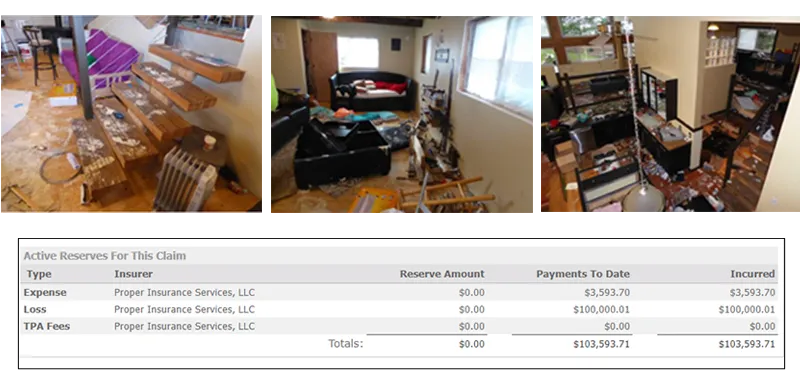
$103,593.71 Payout Due to Airbnb House Party Damage
As you can see in the photos, this client of Proper Insurance had the worst-case scenario happen to a vacation rental owner when it comes to damage caused by a guest.

Our homeowner received a phone call from their neighbor in the early hours of the morning, who said they had called the police because there were over 100 people at their home, cars parked in the yard, and furniture being thrown into a bonfire. The police shut down the party, but the damage had already been done.
As you can see, the total payout for damages is $103,593.71. This is what was paid by Proper Insurance and Lloyd’s of London for the damage caused by a guest. Fortunately, this homeowner had a Proper Insurance policy and was not left to deal with this mess out of pocket like the aforementioned Nashville house party.
$680k Payout After Airbnb Guest Burns House to the Ground
On New Year’s Eve 2019, one of our clients had the terrible experience of a guest burning down their home. The guests left the property and had left embers burning in the house fireplace. A log or ember made its way out of the fireplace, and it turned into a full-blown house fire.
Proper immediately responded to this situation and paid our client $680,568.71 for the property damage and loss.
For many of our clients, their biggest concern is any of the above happenings to their beloved home. We urge you to consider this as you are deciding which policy you want to insure your rental with. It is a simple fact that other companies marketing coverage for vacation rentals could easily not respond to these losses via the exclusion for “Malicious Acts”, vandalism or theft, via property entrustment found in their policies. We aren’t trying to scare you from renting out your property, but simply want to educate readers that these incidents do happen, and the retail insurance market often denies claims. While we might be more expensive than most policies, this is because we are covering these large types of losses, so you do not lose everything you worked so hard to acquire.
Know You Are Covered with Proper Insurance
At Proper Insurance, we’ve custom-penned a policy specifically for short-term rentals. To do so, we have removed all occupancy restrictions and exclusionary language for property entrustment, and there is nothing written about ‘residence premises’. With the property entrustment-related exclusion removed, The Proper Policy is built to respond to incidents caused by your guest staying at your vacation rental. Proper may reimburse you for property and/or contents damages up to the limit chosen on your policy. If you were unable to rent the property due to damages, you may receive payment for business income loss up to your chosen limit for the time you were unable to rent. For example, if you had specified that contents were valued at $80,000, and your business income limit was set to $30,000, Proper may pay up to these specified limits. Below you can find real-life examples of property entrustment coverage assisting our clients and what it could have looked like without Proper Insurance.
Upgrade Your Insurance Coverage Today
Interested in a policy to protect you and your business from a guest’s mistakes? Proper Insurance is the nation’s leading short-term rental insurance provider, protecting homes in all 50 states and replacing inadequate Homeowners/Landlord policies. Proper’s comprehensive coverage meets or exceeds standard short-term rental requirements with $1M Commercial Liability (CGL) and unmatched protection for your property and revenue. Additional custom coverages include guest-caused theft/damage, amenity liability (bikes, kayaks, hot tub, etc.), bed bugs, fleas, squatters, and more.
The Proper Policy covers vacation homes, townhouses, condos, duplexes, cabins, cottages, apartments, and more. With expert vacation rental underwriters, we can tailor a policy specific to your short-term rental property. Proper Insurance is the nation’s leading short-term rental insurance provider, protecting homes in all 50 states and replacing inadequate Homeowners and Landlord policies.
STR Insurance and Property Entrustment: Frequently Asked Questions
Does STR insurance cover guest-caused damage?
A true short-term rental insurance policy, like the one written by Proper Insurance, removes the property entrustment exclusion, so guest-caused damage and theft are covered up to the policy’s chosen limit. A standard Homeowners or Landlord policy typically does not
Does insurance cover theft by a guest?
Under most Homeowners and Landlord policies, no. Theft or burglary by someone you entrusted the property to is the exact scenario the property entrustment exclusion is written to deny. Proper’s policy removes that exclusionary language, so theft by a guest is treated as a covered loss rather than an excluded one.
Insurance Glossary
Short-Term Rental (STR) Insurance: A commercial-style insurance policy underwritten specifically for properties rented to paying guests on a short-term basis. Unlike a Homeowners or Landlord policy, STR insurance is built to cover guest-caused damage, theft, and business revenue loss without a property entrustment exclusion.
Loss of Business Income: Income that is lost due to a slowdown or suspension of operations of the business. For example, a vacation rental owner could experience suspension of business when there is time required to repair or replace the damaged property and the income loss would be covered up to the specified amount in your policy.
Occupancy Restrictions: These restrictions cover the insured policyholder but would insure the policyholder for anyone else’s actions.
Property Entrustment to Others: One of the exclusions that would fall under Occupancy Restrictions within a policy. This exclusion is to disallow an insured from benefiting from an insurance policy for the losses that result from dishonest acts, such as theft, by either the insured or anyone to whom the insured has entrusted the insured property. Given that the person who was trusted with the property is in a position of confidence with the insured, insurance companies do not want to pay for mishaps that occur because of the insured’s poor judgment of character (i.e., malicious acts).


